Analyze and transform the raw data to drive the business.
In today’s data-saturated economy, analytics is no longer a support function—it is a core engine that drives business performance. Organizations that treat analytics as a strategic capability consistently outperform those that rely on intuition or static reporting. At its best, analytics converts raw data into timely decisions, scalable systems, and measurable impact.
Modern businesses generate data across every touchpoint: customers, products, operations, finance, and marketing. Analytics engineering sits at the center of this ecosystem. By building reliable data pipelines, well-modeled datasets, and trusted metrics, analytics transforms fragmented data into a single source of truth. This foundation enables leaders to move from asking what happened to why it happened and ultimately what should we do next.
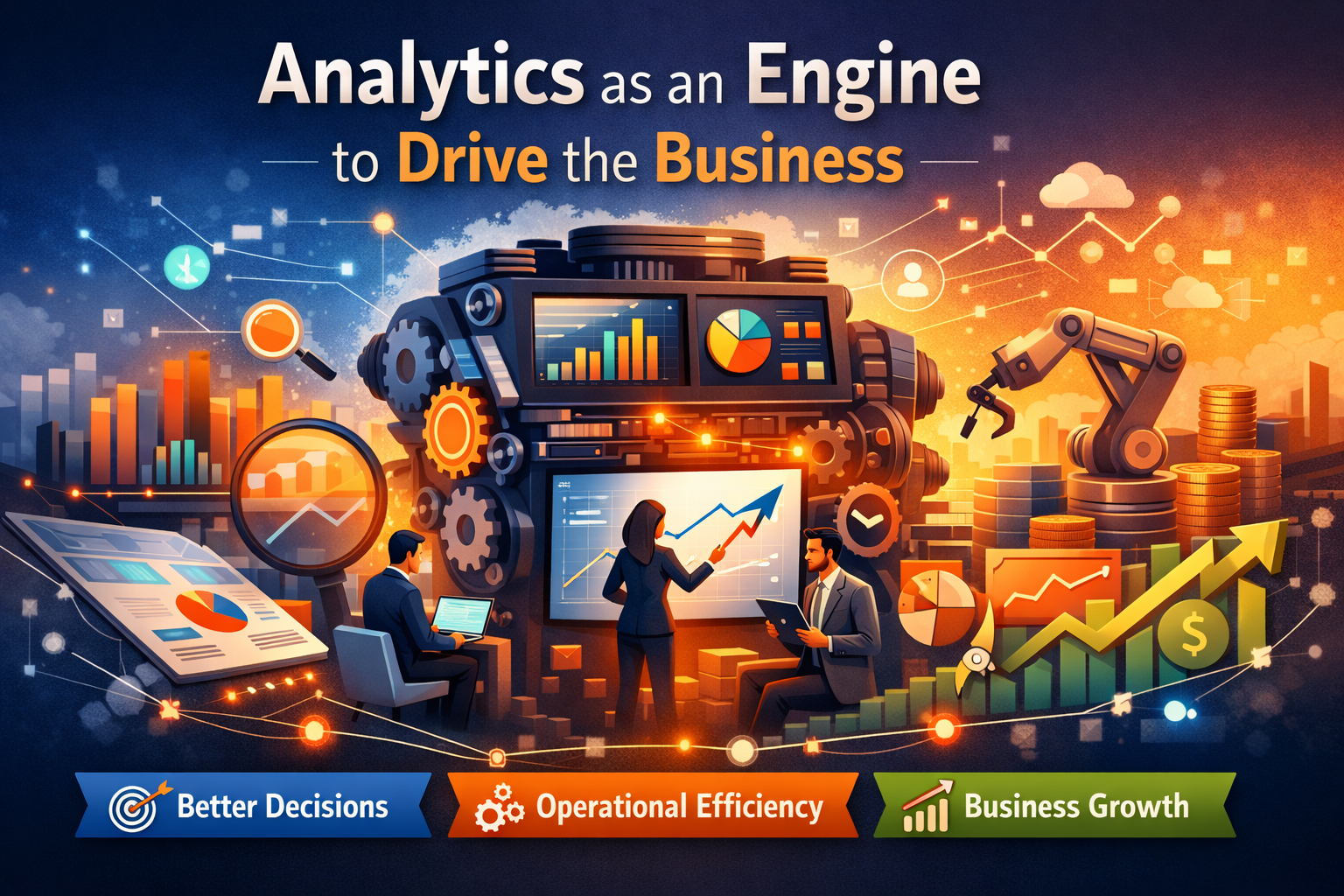
Analytics drives the business in three critical ways. First, it improves decision quality. When teams have access to consistent metrics and near-real-time insights, decisions become faster, aligned, and evidence-based. Second, it unlocks operational efficiency. Analytics identifies bottlenecks, waste, and underperforming processes—whether in supply chains, customer acquisition, or revenue leakage—allowing businesses to optimize at scale. Third, it fuels growth. By understanding customer behavior, lifetime value, and conversion drivers, analytics helps companies invest in the right products, channels, and experiences.
Crucially, analytics is not about dashboards alone. Dashboards are outputs; the real value lies in the systems behind them. Well-designed data models, metric definitions, and governance ensure that insights are trusted and repeatable. This is where analytics engineering plays a pivotal role—bridging raw data and business intelligence with production-grade rigor.
As businesses increasingly adopt AI and automation, analytics becomes even more central. Predictive models, experimentation, and decision automation all depend on high-quality analytical foundations. In this sense, analytics is not just reporting the business—it is powering it. Organizations that invest in analytics as an engine, not an afterthought, build a durable competitive advantage.
Leave a Reply